
 EN
EN
In modern retail, transportation, and commercial environments, display real estate is both limited and valuable. The stretched bar lcd has emerged as a purpose-built solution that addresses one of the most persistent challenges in digital signage: how to deliver clear, dynamic visual communication without consuming the kind of footprint that a conventional rectangular display demands. Unlike standard widescreen panels, this format is engineered around a dramatically elongated aspect ratio that fits naturally into architectural gaps, shelf edges, countertops, and structural columns where no traditional screen could function effectively.
Understanding how a stretched bar lcd improves space utilization requires looking beyond its unusual shape and examining the deliberate engineering choices behind it. From its ultra-wide resolution and high-brightness backlight to its slim profile and flexible mounting options, every attribute of this display format is designed to integrate into spaces that were previously considered unusable for digital content. This article explores the mechanics, applications, and practical advantages of the stretched bar lcd in delivering space-efficient visual communication across a wide range of industries.
The Geometry Behind Space Efficiency
Why Aspect Ratio Determines Spatial Fit
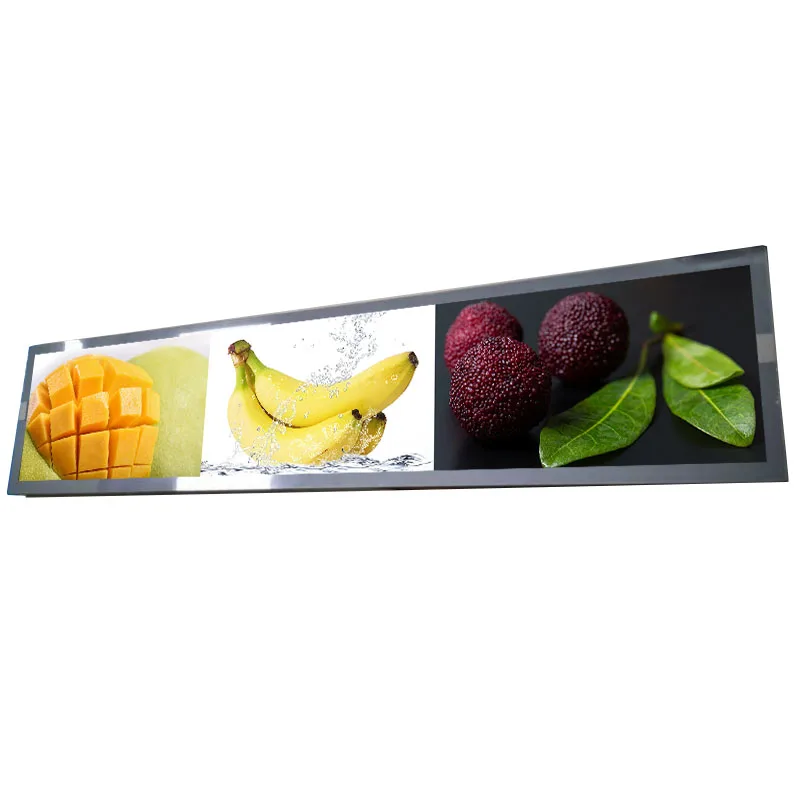
A conventional display operates at a 16:9 aspect ratio, which means it requires significant vertical height alongside its horizontal span. In many commercial environments, that vertical space simply does not exist at the point of intended use. A stretched bar lcd, by contrast, operates at an extreme horizontal-to-vertical ratio — such as 1920x360 — which collapses the vertical footprint dramatically while maintaining a wide, readable horizontal canvas. This geometry is not a compromise; it is a design intent that directly serves environments where vertical clearance is constrained.
The implications of this aspect ratio extend to how the display interacts with surrounding architecture. A stretched bar lcd can be recessed into a shelf rail, mounted flush beneath a cabinet overhang, or installed along a window ledge without protruding into pedestrian space or blocking sightlines. The panel occupies a narrow horizontal band that complements rather than competes with the surrounding environment. This allows businesses to add digital communication to locations that would otherwise remain static or entirely unused.
When planners and designers evaluate display placement, the stretched bar lcd effectively opens up a new category of viable installation zones. Instead of asking 'where can we fit a screen,' the question becomes 'which of these horizontal surfaces can now carry dynamic content.' That shift in thinking represents a genuine expansion of usable display space within the same physical footprint.
How Slim Panel Construction Reduces Physical Intrusion
Beyond the aspect ratio, the physical depth of a stretched bar lcd contributes directly to space efficiency. Modern stretched bar panels are engineered with slim bezels and compact housing that minimize the physical volume the display occupies. In a retail shelf environment, for example, a display that projects several centimeters outward would obstruct product access or reduce the effective shelf depth available for merchandise. A slim stretched bar lcd avoids this conflict by maintaining a low-profile installation that coexists with the functional requirements of the space.
This construction discipline also affects the visual weight of the installation. A stretched bar lcd embedded into a shelf unit or mounted along a structural beam reads as an integrated design feature rather than an afterthought addition. The result is a cleaner, more professional environment where digital communication feels native to the space rather than imposed upon it. For brands that invest heavily in environmental design, this integration quality carries significant value.
Translating Unused Surfaces into Active Display Zones
Shelf Edge and Retail Fixture Applications
The most widely recognized application of the stretched bar lcd is along retail shelf edges. In a typical store layout, the horizontal edge of each shelf level runs the entire length of a gondola or wall unit, representing a continuous band of surface area that conventional displays cannot occupy. A stretched bar lcd fits precisely into this zone, converting passive structural elements into active digital communication channels without reducing product facing or disrupting the shopping flow.
In practice, this means a retailer can place a stretched bar lcd at eye level along a product category to deliver pricing, promotional content, nutritional information, or brand messaging exactly where a shopper's attention is already directed. The display does not require a dedicated mounting structure or a cleared wall section. It integrates directly into the existing fixture system, which means installation costs are lower and the space freed from a wall-mounted screen can serve other merchandising purposes.
The stretched bar lcd also supports product-level content targeting. Because individual panels can be assigned independent content and controlled through a networked digital signage system, each shelf zone can carry contextually relevant messaging. A beverage aisle can display chilled temperature reminders while a snack section shows promotional pricing, all within the same fixture system and without any additional floor space allocation.
Transportation, Ticketing, and Wayfinding Installations
In transportation hubs, the stretched bar lcd addresses a different but equally important space challenge. Airports, train stations, and bus terminals operate in environments where every square meter of floor and wall space has competing functional demands. Overhead structural beams, boarding gate fascias, platform edge barriers, and ticketing counter surfaces all represent horizontal zones where a stretched bar lcd can deliver real-time information without consuming any of the pedestrian circulation space below.
A stretched bar lcd mounted along a gate counter fascia, for instance, can display flight status, boarding instructions, and destination information in a format that is readable from a standing position at the counter without requiring a full monitor footprint on the counter surface itself. This preserves usable counter space for staff and documents while maintaining continuous passenger communication. The narrow vertical profile of the stretched bar lcd is essential to this functionality because it fits within the structural margins of the counter without creating visual obstruction.
Wayfinding applications benefit similarly. A stretched bar lcd installed along a corridor wall at eye height can display directional graphics, maps, and sequential instructions in a horizontal format that guides movement without blocking wall-mounted safety signage or emergency equipment panels positioned above or below it. The spatial precision of the stretched bar lcd format makes it a practical choice wherever information delivery must coexist with regulatory and operational requirements in tight architectural conditions.
Resolution and Brightness Characteristics That Support Space-Smart Design
How 1920x360 Resolution Serves Elongated Content
The resolution specification of a stretched bar lcd, such as 1920x360 pixels, is not simply a scaled-down version of a standard panel. It is a purposefully configured pixel grid that delivers the horizontal pixel density needed for sharp text and graphics across the elongated display surface. At this resolution, a stretched bar lcd can render small-font pricing data, detailed product descriptions, or smooth motion graphics with clarity that holds up at typical viewing distances in retail or transit environments.
Content design for a stretched bar lcd must account for this resolution profile, but that constraint is also a practical benefit. Content creators working with the 1920x360 format are naturally guided toward horizontal compositions — scrolling text, panoramic product imagery, and sequential information panels — that align well with how people read and move through commercial spaces. The resolution supports this content logic without the wasted pixel area that would result from displaying stretched bar lcd content on a standard 16:9 panel with letterboxing or cropping.
High Backlight Output in Competitive Visual Environments
A stretched bar lcd deployed in a retail or transportation environment must compete with ambient lighting that often includes strong overhead fluorescents, natural window light, or external daylight exposure near entrances. A backlight output of 700 cd/m² — as found in high-specification stretched bar lcd panels — provides the luminance needed to maintain contrast and readability under these conditions. This brightness level is significantly higher than what a consumer-grade display offers, and it directly supports the visibility effectiveness that makes space-efficient placement worthwhile.
Without adequate brightness, a stretched bar lcd installed at shelf edge or on a counter fascia would be difficult to read under store lighting, defeating the communication purpose of the installation. The high backlight specification ensures that the space savings achieved through the display's form factor are not traded away by compromised visual performance. The stretched bar lcd delivers both the spatial efficiency and the display quality necessary for professional digital signage applications.
Integration Flexibility and Mounting Compatibility
Embedding the Stretched Bar LCD into Existing Structures
One of the most practical space-utilization advantages of the stretched bar lcd is its compatibility with existing architectural and fixture systems. Because the panel dimensions correspond to standard shelf rail widths and structural beam spans found in retail and commercial construction, integrators can often install a stretched bar lcd without custom fabrication of mounting hardware. This compatibility reduces installation complexity and allows the display to be introduced into an existing environment incrementally, section by section, without a full renovation.
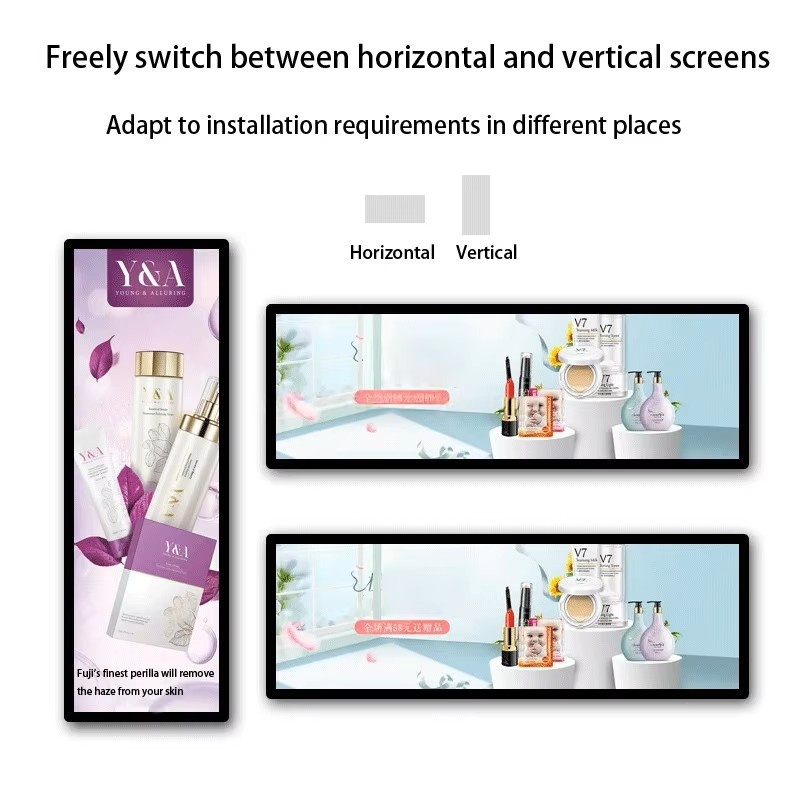
The stretched bar lcd also supports both landscape and portrait-oriented mounting in some configurations, although the landscape orientation is by far the most space-efficient for horizontal surface integration. Mounting brackets, magnetic attachment systems, and direct-embed channel profiles are all available for different fixture types, giving system integrators the flexibility to find an installation method that maintains the slim profile and spatial economy that define the stretched bar lcd format's core value.
Content Management and Multi-Zone Control Across Installations
A stretched bar lcd installation in a large retail or transit environment typically involves multiple panels operating as a coordinated network rather than independent screens. Modern media players and digital signage software support zone-based content scheduling for the stretched bar lcd, which means different panels in different locations can display contextually appropriate content simultaneously without manual management at each unit. This operational efficiency compounds the space-utilization benefit: not only does the stretched bar lcd occupy less physical space per display, it also requires less backend management infrastructure per communication channel than an equivalent number of full-size screens would demand.
Network connectivity options including Wi-Fi, Ethernet, and RS-232 control interfaces allow a stretched bar lcd installation to be managed remotely and updated in real time. For retailers running promotional campaigns or transit operators updating schedule data, this responsiveness ensures that the space-efficient display format also delivers timely, accurate information without requiring on-site content changes at each panel location.
FAQ
What makes a stretched bar lcd different from a standard widescreen display?
A stretched bar lcd uses an extreme horizontal aspect ratio, such as 1920x360, that is far wider relative to its height than a conventional 16:9 widescreen panel. This geometry allows it to fit into narrow horizontal spaces like shelf edges, counter fascias, and structural beams where a standard display would be too tall to install without blocking sightlines or consuming usable surface area. The stretched bar lcd is purpose-built for these installation conditions, not simply a cropped version of a larger screen.
Can a stretched bar lcd be used outdoors or in high-brightness environments?
High-specification stretched bar lcd panels with backlight outputs of 700 cd/m² or higher are well-suited to bright indoor environments, including retail stores with strong overhead lighting and transit concourses with natural light exposure. For full outdoor deployment, additional weatherproofing and potentially higher brightness ratings would be required depending on the specific installation conditions. The stretched bar lcd format is available in configurations designed for semi-outdoor and fully outdoor use in appropriate enclosures.
How is content created for the stretched bar lcd aspect ratio?
Content for a stretched bar lcd is created at the panel's native resolution, such as 1920x360 pixels, using standard graphic design or digital signage authoring tools that support custom canvas sizes. Horizontal layouts, scrolling text, sequential frames, and panoramic imagery all translate naturally to this format. Most professional digital signage platforms include stretched bar lcd templates or allow custom resolution input, making content production straightforward for teams already familiar with standard display content creation workflows.
What industries benefit most from the space efficiency of a stretched bar lcd?
Retail is the most prominent sector, where the stretched bar lcd is used along shelf rails and in-store fixture systems to deliver product and promotional information at the point of decision. Transportation hubs including airports, train stations, and bus terminals use the stretched bar lcd for passenger information and wayfinding in architecturally constrained locations. Hospitality, banking, corporate lobbies, and quick-service restaurants also deploy the stretched bar lcd where counter space and wall space are at a premium but continuous digital communication is operationally important.